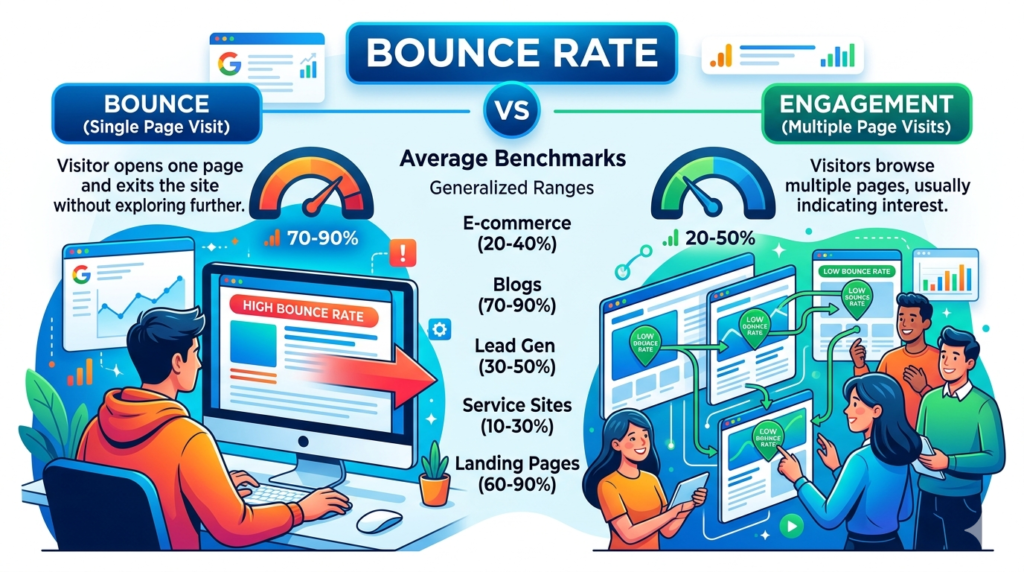
Average Bounce Rate Benchmarks in Google Analytics
In Google Analytics, one of the key performance metrics used to evaluate website engagement is called bounce rate.
Bounce rate represents the percentage of visitors who land on a page of your website and leave without visiting any other pages.
In simple terms, if a visitor opens one page and exits the site without exploring further, that visit counts as a bounce.
On the other hand, when visitors browse multiple pages, it usually indicates they are interested in the content, services, or products your website offers.
Typical Bounce Rate Benchmarks by Website Category
Different types of websites naturally have different bounce rate averages. Below are some commonly observed benchmarks:
- Content-based websites: 40% – 60%
- Lead generation websites: 30% – 50%
- Blogs: 70% – 98%
- Retail / eCommerce websites: 20% – 40%
- Service-based business websites: 10% – 30%
- Landing pages: 70% – 90%
These benchmarks provide a useful guideline for understanding whether your website engagement is performing within a normal range.
Monitoring bounce rate regularly can help businesses identify user behavior patterns and improve website structure, content quality, and conversion performance.